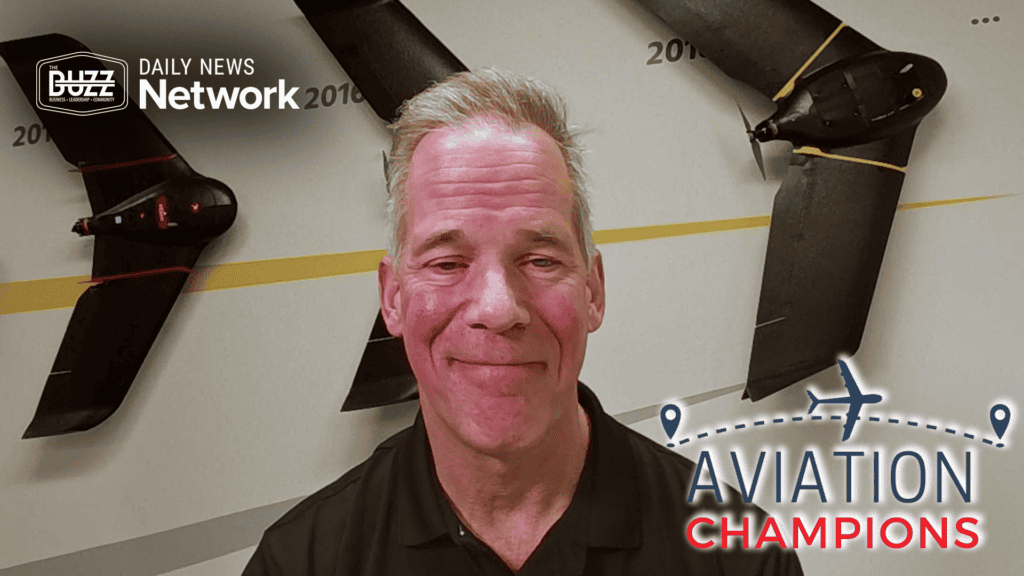
Step into the world of innovation and excellence with “Industry Champions”! Join us as we celebrate the trailblazers who are redefining success across diverse industries, sharing their journeys, strategies, and secrets to thriving in competitive landscapes. Today, our host Miranda Gahn spoke with Bill Irby.
Bill Irby
CEO of EagleNXT
Website Address: https://eaglenxt.com/
Short company description:
EagleNXT is a leading developer of high-performance drones, advanced sensors, and intelligent software solutions that deliver critical aerial intelligence to customers around the world. With more than one million flights conducted globally, EagleNXT’s platforms are trusted across defense, public safety, agriculture, infrastructure, and environmental monitoring applications. The Company’s drone systems have achieved multiple industry firsts, including FAA approvals for Operations Over People (OOP) and Beyond Visual Line of Sight (BVLOS), as well as EASA C2 certification in Europe and inclusion on the U.S. Department of Defense’s Blue UAS list. EagleNXT’s sensors are integrated on more than 150 different drone models and are used in over 100 research publications worldwide, reinforcing its leadership in precision agriculture, surveying, and environmental sustainability initiatives.
What do you consider to be your greatest accomplishment?
The most near-term exciting opportunity is the opening in April/May of our Allen Texas operation which will be our designated headquarters and assembly site for cameras, drones, and emerging products.
What’s The Biggest Challenge you are facing in your business or industry?
A technically challenging HIGH VALUE challenge is in harnessing the most effective AI tools for specific missions that drones performance. Of great interest to us are AI applications in public safety, and precision agriculture.
How do you see your field evolving in the next 3-5 years?
I envision rapid technical and application advances, especially since the FAA is moving to an articulated approved policy for BVLOS flights. At the same time, numerous drone companies are in operation, and the industry is likely to see consolidation.
Transcript:
Miranda:
This segment of Aviation Champions. I’m your host today, Miranda Argon, co-founder and partner of Lux Aero Aviation law firm. Today I’m here with Bill Irby, CEO of of Eagle. Sorry about that, Bill. Go ahead and tell us a little bit about your company.
Bill:
I appreciate that. Thank you, Miranda. Yes, at Eagle Life actually we are a designer and integrator of fixed wing drones, electrically powered, about a four foot wingspan, and a family called the IBI drone system.
We do engineered end to end engineering for a full stack system. We provide these across three markets: military, public safety, and overall civil and commercial, including agriculture.
We also design and build multispectral cameras. We have a wide range of cameras that are not necessarily flown on our drones, but also we sell to the drone market overall, primarily for agriculture.
On that side we have three versions of our IB drone. The oldest of which is the EB X. It is a photogrammetry survey drone primarily used in civil and commercial operations, but it also has been used for military purposes.
The IBI TAC starts to get us beyond the mapping functions and over into real time surveillance. And the EB Vision drone is one that we designed in a multi year effort coordinating with the French Army. The first major release and major sale of that drone was to the French Army.
Since that time we’ve been making modifications and offering that unit in several different markets across the world. But we expand our current production lines from the site in Switzerland to also include EB Vision production in the US. We’ll be opening our plant in Allen, Texas.
So for sure there’s a lot of good change coming for the company.
Miranda:
Wow, sounds like a really fascinating, fast paced business. I bet. About how long have you guys been in business? It sounds like you’re already working on improving your prototypes and you’ve already got a lot of great clients and clientele out there. So I’m just curious, when did you guys get started?
Bill:
So a couple of things of note. I joined the company about two years ago as the CEO, but this company was originally founded by a farmer back in 2010, and it was called AG Eagle Aerial Systems.
Over time they grew out of the agriculture business specifically, and the original farmer that created the business had a hobby flying drones. So he figured out he could apply these to use in precision agriculture missions. Started doing that for a business purpose, expanded out into other civil and commercial fields including surveying, construction, the mining industry, forestry, etc.
Over time that company grew and that company went public, becoming AG Eagle in 2019 through a reverse merger.
When it became AG Eagle Aerial Systems they were able to increase the stock value fairly steadily for a couple of years, enabling us to buy two companies: one called senseFly in Lausanne, Switzerland, and MicaSense that was US focused.
Those are the bases of our two primary product areas today.
Miranda:
Wow, that is fascinating. What a neat backstory. I would guess, myself included, that a lot of our audience is unfamiliar with how drones are used in agriculture. That’s something I hadn’t considered. Would you mind telling us a little more about that?
Bill:
Yeah, great example. Think two different types of uses.
One is for the research heavy end of agriculture where you’re working with universities and agricultural researchers. What you’re using is specialized sensors on these drones to survey large areas of crop fields and to look for things like different plant diseases, insect infestation, and find where you have moisture problems in the soil.
You can do all this through photogrammetry analysis and basically determine where you need to apply the right chemicals or the right fertilizers to your farm fields to get maximum production of food.
Yes, those have been used for a number of years for that purpose. But what’s called precision agriculture is just starting to come into its own, and the market projections for that business alone are quite healthy over the next several years.
Miranda:
Wow, that is really fascinating. Again, I think most people don’t think about agriculture and think about drones. I think a lot of people still think about it simply for photography or surveillance. They associate it with military use perhaps, but agriculture wasn’t on my radar.
So tell me, it sounds like you have a lot of clientele, but are your drones available for market purchase by anyone or do you have to have some sort of special connection or affiliation to get ahold of your drones?
Bill:
So a couple of the older models, the EB X and the EB TAC, can certainly be bought openly on the market. We generally sell through resellers to get to the end customers because ours are generally not used as consumer drones.
They’re more used for specialized service businesses that work in those industries, or the end military customers.
But we have a large network of value added resellers that we work with, and we’re just starting to reach into some other customer communities more directly.
Miranda:
Wow. So what are your big goals for this year?
Bill:
Big goals for this year. We are out there on the W list with both our IB Vision and our EB TAC aircraft.
Our big goals are to close on some fairly near term US Army sales with our IB Vision. We’ve done a lot of demonstrations with the customer and we’ve been part of the conversation going forward.
As I mentioned, we’re W listed and ready for sale immediately to US forces. We’re really eager to get some of those near term military sales moving.
But in addition to that we’re expanding across a number of countries. We’ve announced many of them already online in some of our public releases, and you’ll see more coming over the next few months.
Miranda:
So I would think aviation is a very regulation heavy industry, but drone technology is evolving and I’m not sure that a lot of those regulations have caught up. Maybe you have a different perspective.
What sort of challenges do you see with regulatory and intellectual property concerns regarding your drones?
Bill:
Yeah, really good question. We’ve been working very actively with the FAA, as have many drone providers, on what’s called Part 108 beyond visual line of sight certification.
That’s about to start in an official way.
The FAA released what’s called an NPRM, Notice of Proposed Rulemaking, where they involve industry in commenting back and forth with the FAA on various regulations that were being set up.
Those comments are still being analyzed by the FAA before they publish a final ruling.
But what does this mean in practicality?
For those who don’t know, it means drone operators used to have to get a specific waiver to fly in US airspace for any drone mission at any time.
Under what was called Part 107 you had to get a waiver to certify you for operation for a limited period of time in a limited area.
What Part 108 does is it starts to open up beyond visual line of sight operations based on corridors and safety rules that the FAA is establishing and trying to formalize right now.
Anybody who is able to earn a Part 108 certification would then be open to fly in the US airspace.
Our expectation is once that rule is finally approved and released, that’s going to have a giant effect on opening US airspace for commercial drone operations.
So that’s a big one for us and just as important as our certifications on the military side.
Yes, pretty exciting times.
Miranda:
Well that’s really fascinating. I’m excited to see how that evolution of making drone use more commercial, more prevalent, more useful merges with current aviation regulation in the general aviation space and then the controlled airline space.
Do you have any intellectual property concerns as you’re selling your product to other countries or marketing to other countries?
Bill:
No real intellectual property concerns.
The reason is we’re very careful about following export restrictions as controlled by the Swiss government or the US government depending on how we’re offering the system to the end market.
We follow all export control rules and generally our intellectual property is protected very closely.
Source code stays with us. Aircraft design details stay with us and we retain the team with full expertise.
So I really don’t have a lot of intellectual property concerns.
What the whole industry is concerned about is with all the emphasis being placed on not only Blue certification but manufacturing and building and sourcing parts from the US, all the rules coming out of the current administration.
They’re excellent for US security, but they may not take into account the important partnerships with different NATO allies.
So what we’re trying to do is be responsible for working and solving all the problems for the US market, but for the European and other partner markets as well.
Miranda:
Wow, really great stuff.
As a final question, Bill, what would you like to share about your business, final thoughts or your progression and how you found yourself CEO of a very successful drone company?
Any parting thoughts?
Bill:
Well I appreciate the question.
My big parting thought for anybody watching is please keep an eye on us over the next 60 to 90 days. I think you’re going to see some very exciting stuff come out.
We are eager to make further progress.
So I appreciate your time today, Miranda.
Miranda:
Thank you so much, Bill. What a fascinating topic to talk about. Drone aviation is coming. People don’t realize it, but it’s on its way.
Thank you so much for your time today, Bill.
The Daily News Network, Buzz Tv News, and DAILYBIZBRIEF highlight business professionals, nonprofits, veterans and community leaders on over 40 TV Segments including The Horse’s Mouth, Legacy of Leaders TV, Veterans Buzz TV, Finding Your Frequency, and Buzzworthy Businesses.
Teal, The Agency, powered by Client Focused Media, offers marketing agencies a full-service white-label solution to scale their services without the cost or complexity of building large in-house teams. Tailored for small and medium-sized agencies, Teal specializes in relationship-driven lead generation, advanced CRM workflows for personalized client engagement, and end-to-end project fulfillment. With powerful integrations like HighLevel, Stripe, and Zapier, Teal simplifies your operations while optimizing efficiency—saving you valuable time and resources. While other tools on the market like Vendasta, RocketDriver, and DashClicks, may require contracts, Teal provides flexible, no-contract pricing, giving you the freedom to grow on your terms. Ready to elevate your agency’s impact and efficiency? Explore how Teal can help you deliver exceptional results and better serve your clients. Apply on BeTeal.com today to start your journey toward becoming a marketing powerhouse by understanding digital marketing strategies for agencies, SEO best practices for marketing agencies and scaling a marketing agency.